Review: The Vivisectors
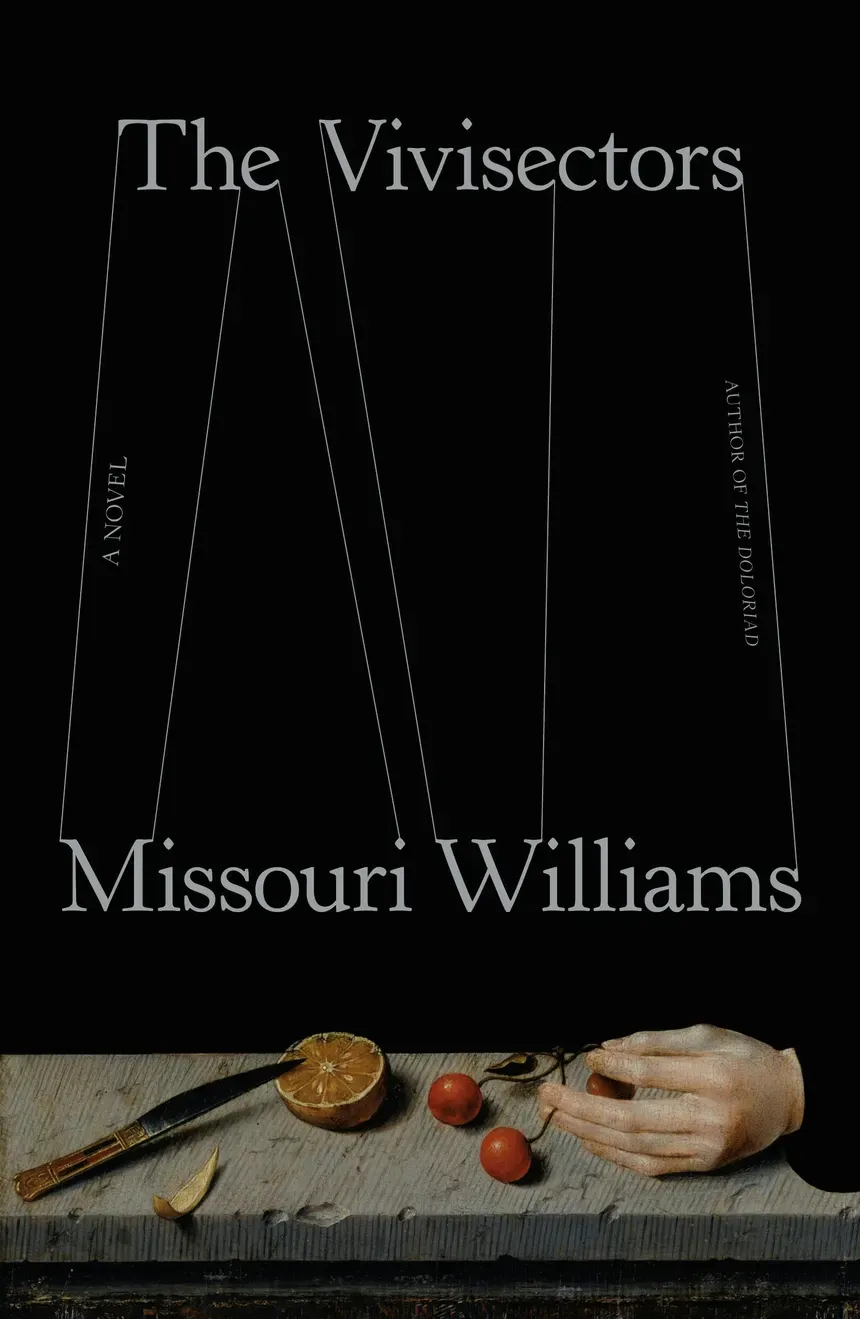
I've been in a depressive episode since May, and it's just past my birthday, and life is so unfair and I'm so tired of everything and everyone. Thinking about doing my job makes me want to barf but thinking about doing activities I enjoy also make me want to barf. I think about a month ago I was still experiencing really hardcore mood swings, bitter hatred and anger towards everyone and everything, but now I've mostly just got anhedonia and I can't even hate myself for my inability to go on morning walks, my refusal to pick the ripening raspberries, my failure to keep in touch with friends and loved ones, my resentment of the effort required to go upstairs and take a piss. Like, I thought to myself the other day that petting my cat seemed like too much effort. "Hey isn't this a book review?" you might be asking, and the answer is yes, but I want to set the stage: I am exactly the sort of pathetic, spiritually inbred lump who should enjoy a book about a nasty resentful little bigot who feels very little and thinks only in a dull litany of exposition, or at least find reading such a book tolerable, since I don't care about anything and feel distant contempt for everyone just like the narrator. Unfortunately, I did not enjoy it. I owe Missouri Williams this much. Thank you for writing a book that was annoying enough that I felt moved to articulate how little I respect millennial novelists.
The narrator of The Vivisectors lives in a college town (excuse me: university city? They're British, probably, it doesn't really matter) that is being slowly overtaken by vegetative growth. She comes from a family of writers and academics; her mother is disabled and tried to kill herself right before the opening of the novel, her father is annoying and cruel, and she lives with her uncle in a sort of watered-down psychosexual Gothic parody house, across the city from her parents (who live in a different type of watered-down psychosexual Gothic parody house; more on that later). The walls are full of mice and the tables are full of animal droppings, the carpet's full of mold and the garden is ever-encroaching, but her uncle's visitors don't seem to mind all that, or the author forgot she'd written all the Gothic details in when describing the visitors. We never really find out, because while The Vivisectors portrays supernatural phenomena, it is uninterested in exploring anything about the uncanny in meaningful depth. Just as wealthy homes often use restrained white lights and candles in windows to differentiate themselves from tacky inflatable-Rudolph-and-blinking-lights houses, so too does The Vivisectors give the impression of self-conscious Halloweenism. Sure, there's magic, but my God, how gauche to expect elaboration of any aspect of the magic beyond how it looks draped over brick walls or how it feels as a restrained religious allegory. These fake spiderwebs are made of silk, not plastic, and they will be removed by noon on November 1st.
As the novel progresses, Agathe's dissociative spite slowly transforms into desperate not-quite-humanity. She works for a boss she hates, goes on long walks she describes with a kind of hollow melodrama (socks full of blood. Really?), befriends and then falls in love with the subject of a campus cancel culture tempest, and observes the slow municipal breakdown of her city as its gardeners go on strike. There are allegorical stories and extensive, sophomoric meditations on the nature of power. Very few proper nouns are used; we are treated to endless repetitions of "the city" and "the university" and "her language" and "what he said". This is the sort of artistic choice that becomes affectation very early on. The book, at least, is short.
Agathe does live in a world roughly like ours in many ways. She sends and receives emails, certain ethnic groups are the subject of conspiracy theories or were subjugated by hundreds of years of slavery, she obsesses over her step count on her phone, cities have apartment blocks and suburbs. I say this because I want to underscore how frustrating I find the coy refusal to engage with the internet as an influential force in any substantive way. So many modern authors, younger ones especially, perform cowardly sleights of hand when portraying a world inflected by the internet. We know the characters are online, but something—terror of seeming dated, paranoia about specificity of platform or subculture, sheer laziness—prevents these authors from using their craft to portray their characters' relationships with technology in a naturalistic manner. Instead we get abstractions, elisions, and too-cute allegories. In Agathe's case this abstention makes reading her first-person narration perplexing in the same way as reading a book review that angrily lists out plot holes that don't exist, or listening to someone discuss the events of a movie they clearly watched while fucking around on social media. She feels incomplete.
This feeling of incompleteness persists despite internet culture and its influence on the novel being discussed in explicit, near-didactic terms. Agathe's boss's child is a statue Twitter fascist, and Agathe listlessly half-agrees with him. The international students, Adam, the boss, many characters interact with Internet culture and speak about its foibles. Agathe herself is relentlessly cynical about power relations, and her interior life (derogatory) will be familiar to anyone who's watched the blue state fascists of Twitter and Substack convince themselves they're not Nazis, or convince themselves that they are, since Nazis have to be willing to kill people in non-aesthetically-pleasing ways. This would probably be tiresome if the novel bothered to stake out any meaningful ideological positions, but you can feel, midway through, the author choosing instead to lean in to religious allegory. Adam, after all, was the first man, and St. Agatha the patron saint of rape victims. Agathe is tormented by dreams of falling down staircases, her father removed all the staircases in their house, and she kills her mother in the last few pages of the novel. This is a trauma plot is a sainthood narrative is a self-aggrandizing parable of the internet. But what it's not is a novel willing to taint itself with details. The fascism stays abstract. The city, choked by nature, is described almost exclusively in trite visual terms. The novel even contains its own meta-critique: it "lacks local colour", but that's not unique to the novel as "almost every world feels abandoned". The thesis is that the internet has changed the world (true) and thus that we're in a sort of mediocre cultural fallow period before spring growth pops out of the ground. The problem is that this is a topic for an essay, not a novel which glances at big ideas like a thirteen year old confronted with the varsity showers.
I suspect that Williams views this as a good thing, or at least that she'd respond to such criticism with praise for the modern novel in all its nonspecific glory. Isn't negative space interesting? Isn't the juxtaposition between the wild, overgrown, magical garden and the crass, urban planning teaching, email avoidant boss so delightful? But the truth is that this conceit, if in fact it is a conceit rather than memetic laziness from a fan of Sheila Heti, is just as annoying to read as the clunkily written yet sweatily ambitious multi-generational sagas of the mid-2000s. Modern writers are always dwelling on literary innovation and scoffing at the concept of trying to tell a good story: isn't plot overrated? Isn't worldbuilding the job of sci-fi/fantasy, which of course we all enjoy but would not deign to write? At some point you have to wonder if perhaps characters that are over-written to the point of parody, or under-written to the point of vapor, serve mainly to compensate for, or distract from, underdeveloped storytelling skills. Innovation in form and subversion of traditional story structure in many newer novels isn't much more than a band-aid. You can always claim that your novel's flaws (rickety plotting, pointlessly contradictory narration, carelessly awful sentences, no setting to speak of) are part of the point, and therefore it is lowbrow to complain about them.
One issue with this lack of specificity is that it makes the book's central plot ludicrously stupid. Adam is being CANCELLED!!! for something he said. We never find out what it is. We never find out his ethnicity, or his professor's, or indeed anyone's, though I lost track of how many times white skin is described in tones of self-conscious reverence. I think that the author is aware that putting an explicit conflict between a rude and sexy maybe-Israeli and a guy who might be Black or Arab or maybe Indian would instantly commit her to a narrative she'd rather avoid—namely, one that can be argued with. Similarly, the book has a trauma plot so clumsily written it made me feel a bit embarrassed to read, but the trauma itself is only ever glanced at; it could be argued that the trauma is the main reason for the novel's dissociative affect, but why bother arguing when we're given so little to work with? I am sure Williams read Parul Sehgal's piece, and I am equally sure that it influenced the on-page cowardice that leads her to write passages like, "Whenever I tried to imagine the house, its image receded. Even when I had lived within its walls something had always stood in the way of my grasping its nature, and so my vision of our family home was of little more than a sequence of dim rooms with high ceilings, each one somehow more hostile than the last, and though to another’s eyes they would have passed without distinction as nothing but neutral surfaces, for me those quiet rooms were filled with horror, albeit one that remained nameless, as I could never quite remember the things that had happened inside them." This is an eminently skimmable novel because the author's own disinterest in or embarrassment about half of its contents is very noticeable. You can feel the moment her own attention slides off the page.
This inattention makes the brief moments of specificity all the more painful, and I don't mean that in a laudatory way. Agathe and her boss both have a prurient interest in disability. There are appalling speeches about autism and leering descriptions of physical disability. I'm disinterested in, shall we say, vivisecting such language from the perspective of the author's psychology; this is precisely the behavior the novel fumblingly attempts to critique, and it's boring. But human psychology is instructive here. Horror is a genre of decision: what details to include and what to hint at. When and how often to show the monster. How to ensure a reasonable portion of the audience sees the ghost, when you still want most of them to only notice something unsettlingly off. Gothic fiction isn't always horror, but it does always engage with horror, and many of the same rules apply. A big scary house with bad memories associated with it isn't meaningful if you can't be bothered to actually write about the house. A decaying city sinking into vaguely supernatural wildness isn't particularly engaging if we don't have a sense of the foundations before they begin to crack.
I don't know if Williams named herself in reference to Tennessee Williams deliberately, though I can make a guess since she's a playwright herself. (Personally I would have simply admitted to myself that I was English, and kept the name Heather.) But Tennessee Williams understood the point of the Gothic: detail. Quentin Compson doesn't say "I dont hate the region! I dont! I dont!" Stanley Kowalski doesn't yell "Wife!!!" The intentionally nameless narrator of Rebecca doesn't dream of going back to "the estate" again, and the contrast between Manderly in all its awful beauty and the nameless narrator is part of the point. The vagueness of Williams' prose is, again, likely intentionally dissociative, but it communicates a lack of care by the author and cultivates a lack of interest in the reader. The abrupt rupture into hyper-specific monologues about autism produces an effect similar to watching a pimple popping video, and I suspect that, too, was deliberate. But it doesn't work. It makes me think Williams doesn't quite understand why people read novels, or why readers pay attention to anything at all. I mean, if I want to read someone being offensive about autism, I can log onto X: The Everything App. A formally ambitious novel should want more for itself.
The worst part about all of this is that there are occasionally touching and meaningful passages. Overheard stories break up the narration several times, notably written as screenplay-esque dialogue between multiple people who interrupt one another and try to pull the conversation back to their own narratives. Here the author employs the usual tools of our trade to great effect. I haven't seen a review that engages deeply with the (to me, obvious) religious themes yet, but I found the writing moving. Outside these sections, the occasional paragraph lifts its head and remembers to have a body, with flow and spirit. Mostly, though, the text just sort of plods on. Cliches abound. Descriptions barely matter, though they will always mention details you'd expect a filmmaker to notice and would hope a novelist would take more time crafting: "The study lay to the right of the living room and was large and light-filled. It occupied the corner of the southern edge of the house and was lined with windows through which the sun invariably seemed to be shining."
The Vivisectors asks us to reconsider our modern habit of pre-judging, abusing power structures to our own advantage, and refusing to see one another. The book's title is introduced in a rant to this effect, voiced by Agathe's boss in a summary of a conversation, not dialogue, the dominant form of conversation in this book. I suspect this is deliberate, and the author believes she is experimenting with form to communicate something important. Isn't interesting how little of the book contains true dialogue, when the book itself is so concerned with the ways in which we misunderstand and hate one another? Similarly, mirrors are a recurring and obvious motif: what do we see when we look at ourselves? What do we do when we project ourselves on others? But answering these questions requires writing actual scenes or committing yourself, at the level of the sentence fragment, to imbuing your non-scenes with meaning. Williams accomplishes neither. The second paragraph of the novel contains the sentence, "He was a frail man, older than his sister, my mother, by a good twenty years." The entire passage is concerned with Agathe's family; there is no reason to insert "his sister, my mother," when you could communicate this less clumsily two sentences later. The book does not improve from there. It invites close reading and then spurns every attempt at doing so.
At the end of Agathe's boss's rant about vivisectors, Agathe remarks to herself, "I was impressed to discover she had learned a new word, but inside I was thinking that none of this applied to me." The novel's main achievement is making such arrogant contempt incredibly memorable, while lacking the craft to truly examine or transform it.