Liberal Currents: A Practical and Strategic Analysis
Hancox-Li's stated intent is valuable. Her essay is a failure.
A few days ago, Samantha Hancox-Li published Prairieland: A Practical and Strategic Analysis. Her introduction lays out her intended framing and thesis:
Thus, this is not an essay about the morality or immorality of the events at Prairieland. This essay treats morality as irrelevant. It is a cynical essay, an exercise in cold-hearted strategic and tactical analysis. It asks: what did the Prairieland activists intend to achieve, and were the tactics they adopted successful to that end?
Cards on the table: they weren't successful. The events at Prairieland on July 4, 2025, resulted in a large number of activists arrested, no national upsurge in anti-ICE sentiment, and legal and propaganda victories for the government. A tactical analysis of Prairieland is a case study in mistakes. But negative examples are nevertheless useful for future organizing.
I think this is a good idea for an essay, and more importantly, a necessary idea for an essay. Anyone hoping to defeat the Sons of the Confederacy's earnest efforts to ethnically cleanse the US and reinstate Jim Crow nationwide, in other words, anyone opposed to American fascism, should be thinking about Prairieland. It's a horrifyingly egregious case of state repression and a strong example of how black bloc tactics can go extremely wrong. I fully support critically analyzing it. Unfortunately, Hancox-Li's piece fails both to be adequately cynical and to be a real analysis. It is instead a self-serious summary of the prosecution's arguments against the defendants, sprinkled with quotes from relevant readings, links to articles she seems to assume the reader won't review, and frequent reminders that shooting a cop is a bad idea.
The Prosecution Rests
Throughout the essay, Hancox-Li informs her reader about details of the event and trial through allusion and summary. She doesn't spend much time on relatives' interviews, extant published writing, or any other documentation that might provide the reader with insight into the defendants' goals, though embedded links suggest she reviewed plenty of such material. I'm not sure if Hancox-Li assumes her audience is already aware of the individuals involved in the case, or if she doesn't think such insight is important in this analysis; she opens her essay talking about existing writing on the trial and her intention to provide a different framing, and consequently I tend to assume she's writing against the mostly-sympathetic mostly-leftwing documentation she links to. If her assumption is that she's writing for people already knowledgeable about the trial, she misses the mark. She repeatedly raises the question of "goals", opening a section titled "Ends, ways, means" with the following musing:
Did the Prairieland activists achieve their goals? There is always some interpretive difficulty in identifying the "theory of the case" of diffuse mass movements. Even relatively small groups, like the Prairieland activists, are not prone to hierarchical bureaucratic structures and clearly articulated statements of policy.
On the other hand, there are the zines—the reading material of the book club to which many of the Prairieland activists belonged, and which proved so relevant at their trial (a topic to which we will return). None of these were of course the official "doctrine" of anything like a "North Texas Antifa Cell." Nevertheless, some of them articulate ideas we can see at work in the events of July 4.
She then quotes two anarchists and uses these quotes to support the following framing of the activists' goals:
If the ultimate goal is to end the mass deportation regime, then this requires some form of national political change, whether that comes in the form of a general strike or a general election. The goal of individual "attacks," therefore, is to activate large numbers of people to engage in the cause.
The "noise demonstration," aka the setting-off of fireworks, served the additional goal of communicating to detainees that they are not alone: that there is someone out there who cares about them and is willing to fight for them. Of course, this may also have the effect of activating larger numbers of people to the cause.
I think this is a fair assumption, given what we know of the Prairieland defendants' ideology. You might expect an analysis to then delve into how we define a specific action's goals, the difference between a short-term goal like demonstration of solidarity and a long-term goal like the total abolition of our brutal immigration system, the challenges of achieving anything as a relatively small group, the operational challenges presented by ICE concentration camps, the role of electoral politics and the problematic nature of anarchists' long-term revolutionary goals in contrast with the urgent crisis of Trump's mass deportation scheme, etc. In other words, upon summarizing two fairly straightforward goals, the reader then expects deeper exploration of these goals and how they connect to the broader movement. Hancox-Li eschews such analysis. Instead, she drops two brief paragraphs saying they did not achieve these goals and the feds caught them easily and wraps the whole topic up.
In these two paragraphs, we also get a reassertion of the piece's thesis, this time in the form of preemptive defensiveness:
Whether you think their actions were villainous or heroic is not my concern.
I'm certainly not opposed to analyzing Prairieland dispassionately, but I'm interested in the juxtaposition between this statement and Hancox-Li's assertion that the defendants "struggled to achieve sympathetic media coverage" and "failed to achieve positive virality in the larger culture". The imagined defensive reader, presumably, loves the Prairieland defendants and thinks they did nothing wrong. This is, Hancox-Li says, obviously an unpopular opinion. All true! But a "practical and strategic analysis" with a shadow thesis is neither practical nor strategic. Large parts of this piece seem to badly want to address anarchists and/or black bloc tactic enthusiasts directly and tell them that their ideas are bad, their rhetoric is cringe, and their people fucked up bad here. Without actually articulating this sentiment, however, we're left with an already-familiar conclusion: people who go to a noise demonstration at a concentration camp and are around when one of them shoots a cop will not be popular with the American public.
Hancox-Li uncritically regurgitates the prosecution's arguments throughout her essay, but the second section, titled "The uncontrollability of violence", is by far the most egregious in this regard. "According to Song," Hancox-Li tells us, "he was firing warning shots[...]Maybe this is true—but it hardly matters[...]Song fired an AR-15 in the direction of a police officer; once you do that, the results are not exactly under your control." Later in the section, she summarizes events again by saying that when police arrived "and one of them drew his sidearm, Song fired his rifle and struck a police officer." To her, it would be a "mistake" to characterize Song as "being a hothead", because "Song's actions are an unsurprising result of culture and doctrine among the Prairieland activists. This isn't particularly complicated." (A close reader might feel compelled to ask why an event defined by the shooting of a cop needs a "practical and strategic analysis" if the inciting event and the ideology motivating it "isn't particularly complicated", but I digress.) This account is missing a glaring detail, however, and unlike when Hancox-Li discusses the Prairieland defendants' zines, the details aren't linked in the passage eliding them.
Song published a statement after their sentencing (per the linked website, Song's pronouns are they/them). In this statement, they describe their decision-making process:
When I saw Lieutenant Thomas Gross stop pursuing and point his gun at the back of a running, unarmed protester, like he testified, I was terrified. As a firearms instructor and a United States Marine Corps veteran, I understood what I was seeing. I knew what it meant for someone to lean forward into a gun, like he testified, to prepare for recoil.
So in fact, according to Song, they shot at the cop because they were confident the cop was about to shoot and kill another protester.
Song's full statement is written in a style that will be familiar to even a casual Anarchist Library reader, and whether or not you find it particularly persuasive is likely down to personal preference and existing political beliefs. Regardless of how Hancox-Li feels about anarchist politics, I would expect an analysis of an event that revolves around someone shooting a cop in the neck to spend a little more time on the shooter's statement. The prosecution claims that Song deliberately ambushed police officers; defense attorneys were prohibited from arguing either self-defense or defense of a third party during the trial. But of course this is a "practical and strategic analysis" of the Prairieland defendants' actions, not a true crime podcast. The minute details of the trial don't matter, but the delta between the prosecution's narrative and Song's very much does.
Prosecutors argue that the cache of weapons, body armor, and first aid supplies the demonstrators brought to the protest indicated they planned to ambush police. Hancox-Li says that "the activists very much expected [police]", but offhandedly mentions that the Prairieland defendants brought weapons specifically because they "were worried about the presence of armed counterprotesters—viz., white supremacists with guns." Everyone else left their guns in the car, but Song brought theirs to the action.
Practically and strategically, I think there are interesting lessons to be gleaned from this. The Prairieland defendants planned an action that was at most ambiguously legal: what can be learned from the knowledge that prosecutors will successfully spin a narrative of "ambush" should the protest become violent? Song choosing to take their rifle even though the others left their weapons in their vehicles is potentially much more risky than all members being armed, because when all weapons are in the possession of their owners, those people's positions and what they're doing with their weapons become evidence of intent, whereas if the weapons are mostly in a car except for one person, you can write a lot of fiction about what the real plan was. But then, it's possible that all protesters carrying to the protest would trigger a larger and harsher police response, or that more of the armed protesters would have itchy trigger fingers. I think an analysis would benefit from spending time on either or both of these arguments. (It goes without saying that being unarmed is the least risky, assuming your risk is political persecution stemming from a protest where someone shot a cop.)
Song's own recounting of the shooting raises further questions. I'm not inclined to adjudicate whether or not they're lying, only because I think the objective information we have from surveillance video is enough to say that their claimed evaluation of the cop's intentions is not just plausible but likely: we know for sure the cop drew on fleeing people. Their lives were definitely in danger.
"One person shows up to a protest with an AR-15" isn't too unusual, so I think it's worth spending some time on Song's mindset and thought process. Assuming in good faith that their representation of their goals is accurate, Song brought their rifle to serve as a deterrent, with no plans to shoot anyone and no desire to ambush cops. Of course, any time you bring a weapon with you, you should be prepared to use it. I'm not sure there's much utility in debating the fact of bringing a gun to a protest specifically because this isn't unusual; if you go to a lot of protests, eventually, you'll be at a protest where at least one person is carrying. The chances that this happens at left-liberal protests rise dramatically in places with influential gun cultures, Texas included. I'm interested, then, in the sorts of dilemmas you weigh as someone in this situation, from either end. If you're at a protest and someone near you has an AR-15, should you always leave the protest? Should you ever attempt to talk to them? Is leaving the protest even necessary, or can you distance yourself effectively from them? Some of these might have more obvious answers than others, but Hancox-Li's analysis doesn't engage with any such questions.
Song's dilemma is tougher to think about. To try and stop a cop from killing another person, they allege that they shot at the ground and got very unlucky with a ricochet. They seem to have been completely unprepared for the possibility that they'd shoot someone; the other defendants seem to have been similarly unprepared for the possibility of violent escalation. Several of the defendants, including Song, had experience with protests and police brutality, but they don't seem to have had a very tight plan for what to do when everything goes sideways. The presence of a gun isn't incompatible with peaceful protest everywhere in the US, but the presence of a gun is a guarantee that your side could shoot someone. Failure to plan for that contingency cost them.
If you are someone carrying a gun to a protest, Song's recounting of their decision to shoot is also worth thinking through. It's a split-second decision: a cop is about to shoot someone. Will you fire to protect them, or will you let that person become a martyr? The latter is a more politically powerful choice by far, but of course it means you've failed to save a comrade's life, which for many would be psychologically devastating. By the time someone pulls a trigger, you've already guaranteed escalation. I'm not sure there's a right answer to this specific dilemma, even if there are right answers lurking in the lead-up and aftermath.
Every single aspect of a protest or action potentially carries risk, and effective resistance will always have trade-offs. Prairieland, like many ICE concentration camps, is a 30-minute drive from an urban downtown (Fort Worth). In Texas, like many other Republican-controlled states, guns are deeply embedded in culture. Because of these factors, anti-ICE campaigners attending or organizing mass demonstrations should be answering all of these questions and discussing it among themselves.
Hancox-Li analyzes none of this. She summarizes the events using the prosecution's allegations and timeline, points out that shooting a cop was a severe escalation, and moves on. A protest where someone shoots a cop is always going to end badly for the person who shoots the cop, but we're talking about the Prairieland Twelve: a lot of other people got swept up in this, and right now, for liberals, the prosecution's framing is the analysis. The center can't hold on this one.
"Noise demonstration"
Hancox-Li repeatedly reminds her readers that she intends for her analysis to be cynical, a "cold-hearted strategic and tactical analysis", yet the essay contains very little analysis focused on the demonstration itself. I suspect she views the demonstration as unimportant relative to its bloody conclusion, but of course you can't really claim to be analyzing the Prairieland defendants' strategy and tactics if you exclusively focus on the one event all of the demonstrators say was unplanned. Most black bloc actions don't end in a cop getting shot, even the ones where people bring guns. Consequently I think it's fair to ask: okay, what actually happened?
Hancox-Li defines the Prairieland demonstrators' action as a "'noise demonstration,' aka the setting-off of fireworks". She mentions that the demonstrators surveilled the site ahead of time. She talks about their focus on "opsec", which she characterizes as "use of encrypted chats such as Signal, or the practice of not taking your phone to a protest". She ends two paragraphs talking about opsec and security culture with similar remonstrations: "if you shoot a cop in the neck, the gaze of the state will fall upon you like a hammer[...]If you shoot a cop in the neck while attacking an ICE facility, multiple federal agencies are going to come looking for you." The rest of her musings on opsec are confined to a narrative that will already be familiar to the reader: the federal government will out-opsec you. You cannot hide from them. The moment you shoot a cop, everything you say and do becomes evidence. etc.
Of course this is true. But Hancox-Li's analysis is so thin it can barely be described as such. She seems to implicitly accept that anyone associated with Song is guilty of conspiracy to shoot a cop, but of course we know that this is unlikely to be true, just as we know that regardless of truth, the government will pursue a narrative of premeditated terrorism if such a narrative is useful to it. She doesn't analyze what the cops found in the demonstrators' homes or on their phones; she doesn't analyze the seeming lack of a plan for the potentially bloody confrontation she claims the protesters originally anticipated, and she also doesn't analyze the lack of a plan for what actually happened (one person open carrying and shooting a cop). Song was a fugitive for 11 days, but this piece doesn't mention that, nor does it mention that the demonstrators were originally charged with attempted murder, and only after Charlie Kirk's assassination, Trump's signing of an order designating "antifa" as a terror organization, and Trump's signing of NSPM-7, were the charges upgraded to terrorism and material support for terrorism. Operational security includes things like knowing what you're likely to be charged with and just how illegal your activity is, and tactical analysis surely encompasses discussion of the government's novel ability to claim being at a protest where a cop is shot is material support for terrorism. Hancox-Li apparently disagrees.
I mentioned that Hancox-Li claims that the protesters brought weapons because they were worried about violence from counter-protesters. She doesn't source the claim and I wasn't able to find it in her embedded links, but she does link to a Texas Observer article that characterizes the demonstration very differently:
Ahead of the protest, members of a Signal group chat discussed whether they should bring guns. Benjamin Song, a former Marine reservist and the alleged shooter, argued firearms would deter an escalation if a confrontation with police occurred. “Cops are not trained or equipped for more than one rifle,” he allegedly wrote, “so it tends to make them back off.” Police recovered 11 firearms from the arrested protesters, many of them inside cars or unassembled in backpacks. Multiple belonged to Song. Prior to his arrest, Song was affiliated with the Elm Fork John Brown Gun Club, whose black-clad members have routinely carried long guns at protests across North Texas over the last few years without violence, including during a standoff with Dallas authorities that delayed the clearing of a homeless encampment in July 2022 and did not result in any arrests.
Knowing this, I doubt the demonstrators were worried about counter-protesters, since they would have then had reason to suspect a mole in their chats: this wasn't a publicly advertised protest! It was a very small group of people who intended to do a noise demonstration in front of an ICE concentration camp, and everyone except Song appears to have informally decided against the thesis of police intimidation.
A tactical analysis, too, should probably talk about the claims made by demonstrators regarding who actually showed up. From one of Hancox-Li's links:
The first surprise was the arrival of someone they’d never seen before. Not long after Morris’s minivan got to Prairieland, the group watched as an unfamiliar white Nissan Rogue approached. The driver’s side window rolled down, revealing a blond, blue-eyed twenty-year-old man who could easily have been mistaken for a high school student. “Hey, I’m Nate,” he said after he parked his car. Then, realizing that no one would know who Nate was, he clarified, “My name is Bible.”
Earlier that day, Bible had been an assertive presence in the larger Discussion and News chat on Signal. He had claimed to be a veteran activist who had been arrested many times and whose parents were at risk of deportation. But the Bible behind the wheel matched none of these particulars. He had made them all up. He was, in fact, a kid named Nathan Baumann from College Station.
[...]
Graffitiing cars doesn’t seem to have been part of the group’s plan, but Baumann had brought a can of spray paint. He first told authorities that Seth Sikes, an SRA member who had traveled on his own to Prairieland that night, had vandalized the vehicles but later said he had done it himself, along with another protester named Zachary Evetts.
So at this point we have: a small noise demonstration planned by members of various Signal and Discord group chats, who were also participants in local gun clubs and anarchist publishing efforts, carried out by some of those same people, who hadn't always met each other in person before and at least one of whom was lying to the others about his biographical details, with no specific plans regarding intent to carry or use firearms, with no discussion of permissible or impermissible tactics, which then went south, resulting in unprecedented federal terrorism charges for people who were at the demonstration as well as their families, friends, and loved ones. Hancox-Li does not analyze any of this. Instead, she says that, rather than blaming "'snitches' who ruined everything", "[i]t is simply impossible to prevent at least some people from talking to the police once the crowd size passes a certain point, and even more so if someone has shot a cop. No amount of security culture is going to prevent this."
At the risk of becoming repetitive myself: everyone knows Song shot a cop. That isn't up for debate, nor have many people argued it was strategically wise. But the demonstrators made a lot of other mistakes. They didn't set limits on type or use of weaponry, they planned illegal activity with people they hadn't met before, they didn't agree on what they would and wouldn't do. These are all practically and strategically relevant to all analyses of the demonstration and its aftermath. I'm sympathetic to reading descriptions of the group chats or the individuals' behavior or politics and finding them distasteful, embarrassing, or outrageous. But if you intend to cynically analyze a demonstration, I do think it helps to understand what sort of demonstration you're analyzing and why things went so wrong (beyond shooting a cop). I don't know if Hancox-Li lacks understanding or if she simply chooses not to enlighten her readers because she disagrees with the demonstrators' politics and tactics, but I do know that the essay is infinitely weaker for not bothering to engage with the actual material reality of both what was planned and what wasn't.
Cui bono?
Hancox-Li has a lot of ideas about the demonstrators' motivations and politics. In the section "Radicalism for radicalism's sake", she quotes anarchist A. G. Schwarz and summarizes activist Jonathan Smucker to argue that the Prairieland defendants were motivated by "proving one's radical bona fides within the movement, and therefore securing one's social standing" over achieving their ostensible political goals. She seems to feel the connection between Smucker's work with people he knew organizing anti-IMF protests in 2000 and her analysis of the Prairieland defendants' statements, chats, and writing is self-evident, as immediately after arguing that some people's participation in radical movements is an exercise in narcissism (true), she says, "one can see" that the Prairieland defendants' "obsession with assault rifles and armed standoffs, the black clothes and ski masks, the opsec cult" is "calculated to alienate normies while elevating one's status with a fringe clique. Mere tactics disconnected from real strategy."
This may well be true, but it's not analysis so much as slapdash biography. I find it curious that Hancox-Li's argument is weaker for all the detail she leaves out. I think it's fair to claim, for example, that "Bible" may have been motivated more by in-group status than politics. I'm dubious that the same can be said for many others, including Maricela Rueda, Dario Sanchez, and Daniel Sanchez Estrada. That ICE concentration camps are an extremely alarming and activating phenomenon shouldn't be discarded under the fig leaf of cynicism: it is relevant to serious analysis.
I personally hold the subjective view that when left or liberal protesters of any kind are prosecuted by the state, the decent thing to do is seriously consider the politics, ideology, personal motivations, and failures that brought them there. The demonstrators' electronic communications were evidence in the trial. We know that some of them were earnestly committed to their politics. You can argue that subconsciously, all of them were also motivated by a desire to be cool with the in-group, but I don't see the utility in doing so except to dismiss the questions that real analysis would raise. The DFW, like all metro areas, is more liberal than the rural areas surrounding it, but even taking that into account, the demonstrators had unpopular politics. Some of them are Latino, and some of them are trans. They were relatively isolated, in other words, and I think it's reasonable to assume that ICE's escalations influenced demonstrators' mental and emotional states. In July 2025, ICE had been surging in LA for a month. Three months prior, Todd Lyons had announced he wanted to deportations like "Amazon Prime for human beings". This announcement was itself about three weeks after Kilmar Abrego Garcia, along with many others, was branded a cartel member and shipped to CECOT, which we knew at the time was a foreign torture camp.
A "practical and strategic analysis" doesn't have to assume that all of the Prairieland demonstrators felt any specific way about ICE's increasingly authoritarian abuses. Such an analysis could credibly argue that however bad the material conditions were, the politics of confrontational anarchism worsened outcomes. But I do think any competent analysis should consider the influence a heightened mental or emotional state might have on demonstrators. People who panic often do dumb shit. People who believe they're facing down a fascist government will behave differently than people who believe they're facing down a democratic but uncaring government. Their state of mind matters, both practically and strategically.
Hancox-Li's disapprobation of the demonstrators' politics also mars the promised section on zines, "Reflections on the zines". "It is important to be precise here," Hancox-Li says; some of the "readings[...]quite explicitly advocate for engaging in illegal activity and provide tactics and justifications for doing so". She's not opposed to reading these zines, telling her readers that "[i]t is not illegal to possess, read, or distribute these texts. Perhaps you should", yet she does see them as "a case study for activists in the limits of the First Amendment". To illustrate such a case study, she references Nicholas Decker's essay "When Must We Kill Them?" to make the argument that if you read an essay about killing members of the federal government and then go kill members of the federal government, the government can plausibly argue the essay is evidence of your crime, and removing copies of it from your house is thus criminal. Hancox-Li replicates the prosecution's unproven claim that Daniel Sanchez Estrada was specifically instructed to remove zines from "Rueda's house" (Sanchez Estrada disputes both the timeline and characterization, claiming it was his residence as well), and then says that because this instruction occurred, and because some of the zines advocated for illegal activity, Sanchez Estrada "was convicted of tampering with evidence, because he was tampering with evidence." She wraps concession with condemnation: "while the continual cry that Estrada[sic] was convicted for 'moving a box of zines' is perhaps effective propaganda, it remains bad tactical analysis. The First Amendment will not protect you if you are attempting to hide evidence! You, activist, should not expect it to!"
Prairieland defendants are still appealing their cases, and my understanding is that Sanchez Estrada is indeed appealing on the basis that this impinges on his First Amendment rights. I'm not a lawyer so any analysis on this from me would be useless. But as someone who reads broadly and attends protests, I am interested in what actual liability such an interpretation of "evidence tampering" might confer upon me. It seems to me that Hancox-Li puts a thumb on the scale when using Decker's essay as her example for why such an argument from the government is plausible. Yeah, if I read a book about doing something and then go out and do exactly that, obviously the book might be evidence of intent. But that's not what happened with the Prairieland defendants. There's no evidence they planned armed insurrection; there's also no evidence they planned to ambush a cop. The connection between the zines and the action seems no different to me than the connection between reading The Girl with the Dragon Tattoo and then murdering your wife, but I don't think anyone is tampering with evidence if they find the book after the murder and throw it away.
What seems salient to me about the zines is that the government has successfully argued that possession of such material is evidence of criminal intent, even if your own stated intentions and plans are inconsistent with the crime the government alleges you committed. It's a fact that Rueda intended to commit crimes such as trespassing and that some of the zines advocate for committing such crimes, but the zines also advocating for insurrection doesn't mean that Rueda ever intended to engage in insurrectionist activity. This is not a legal argument but rather a logical one, and it's important because the Prairieland defendants' convictions would seem to indicate that if the feds choose to charge you with terrorism and you possess material advocating for terrorism—regardless of how consistent that material is with your actions—the material is evidence of intent. I would expect a practical and strategic analysis to take this ambiguity into account while discussing both what went wrong with Sanchez Estrada and Rueda and how this successful conviction might or should influences others' behavior. Instead, Hancox-Li wraps up the zine section with yet another reiteration of her primary analysis, namely that "[w]hen there's a cop on the stand with a big scar on his neck from a 5.56 round, juries are less sympathetic."
Nicollet Avenue
Details of geography and associated cultural and political differences don't seem to be something Hancox-Li is particularly interested in. In the section "Playing to win", Hancox-Li opens with a quote from a defendant's attorney, who says that "the fact that there was a gun present and that the black bloc participants did not conform to certain standards of respectable activism" led to their onerous sentences. She responds to this quote with a long series of arguments: this isn't a soccer match; "whining about unfairness" isn't reasonable when we're in "a desperate struggle for the future of the republic". Bias is to be expected: "Of course the judges are Republican hacks who spend the rest of their time screaming about the trans menace." She links to other cases where defendants successfully fought off their charges: the Broadview Six, the DC sandwich guy, and a Tennessee man who won a civil case after being arrested for posting insulting Charlie Kirk memes. She opens two consecutive paragraphs with the same assertion: "[t]he Prairieland events, by contrast, met the administration on exactly the terrain the administration wished to be met on", and "[t]he Prairieland activists decided to meet the administration on the field the administration picked and deliver them the fight the administration wanted." Then she brings up Minneapolis.
I will discuss this section in the order in which these arguments appear.
First, the defense attorney. I'm not sure why a "practical and strategic analysis" seems to be using a defense attorney's quote to represent "whining". It seems obvious to me that defense attorneys represent their client's interests, and this includes press. The demonstrators frequently evince a very casual attitude towards disruptive protest, and it's difficult to glean from news coverage if any of them had thought about or discussed just how wrong things could go, if they went wrong. A common theme in news coverage of the event, including the coverage Hancox-Li links to, is that the demonstrators viewed the noise demonstration as low risk. The guns were prophylactic and the fireworks weren't going to be aimed at anyone. People can have casual attitudes towards objectively risky behavior for reasons ranging from ignorance to over-confidence, so one might expect analysis regarding evaluation of threat models prior to engaging in civil disobedience. Hancox-Li declines to dig deeper.
Useful analysis of the defendants' assumed risk might also include considering salient differences between civil and criminal penalties, or between juries in the Dallas/Fort Worth exurbs and juries in Chicago or DC. The Broadview Six had their charges dismissed in part because of egregious prosecutorial misconduct; had they faced a more hostile judge, it's possible their trials would have gone very differently. Juries in DC are a lot more tolerant of non-injurious direct action like throwing a Subway sandwich at law enforcement than juries in most rural areas around the US. Winning a civil case in relation to an open and shut violation of your First Amendment rights is not the same thing as winning a criminal case where you've been charged with trespassing or vandalism, much less attempted murder, much less terrorism. Hancox-Li doesn't seem to think these cases are exact comps, but she doesn't analyze the differences between them. To her, the difference is self-evident: the Prairieland defendants were present when one of them shot a cop. That's all that matters. Practically and strategically, I agree, it would be better if no one had shot a cop. But while ICE continues to build and fill concentration camps in service of their plan to detain, torture, and deport millions of US residents, we can reasonably expect that people seeking to end ICE's mass deportation regime will find themselves in hostile territory for demonstrations both legal and illegal. It seems likely to me that, having successfully redefined the legal limits for what can be described as conspiracy, material support for terrorism, or terrorism itself, the government won't rest on its laurels and decline to pursue inflated charges and onerous sentencing in cases where no one shoots a cop. The judges said it themselves: the convictions were intended to serve as deterrents. They were cruel on purpose.
Practically and strategically, then, what should we all do? Should we not protest in front of ICE concentration camps at all? Should we refine our vetting and planning process for such protests? Apart from not shooting a cop, is there anything else the defendants could have done to protect themselves? Hancox-Li is uninterested in such questions except by implication: "the ordinary citizens of Minneapolis, and their resolute nonviolence, even in the face of brutal murders committed by agents of the state, have done far more to change national opinion on the mass deportation machine[...]this cynic notes that there seems to be an advantage to wrapping yourself in the flag and declaring that your goal is to save America, as opposed to dressing all in black and explaining how your goal is to destroy it". She quite literally leaves it as an exercise to the reader to determine—or analyze—if wrapping yourself in an American flag while shooting off fireworks in front of an ICE concentration camp in exurban Dallas/Fort Worth will protect you from malicious prosecution.
Being in Minneapolis and participating in our resistance to ICE in a marginal capacity has accustomed me to people making broad generalizations about our activities which range from incomplete to flat-out wrong. I had higher hopes for a practical and strategic analysis of an act of resistance that preceded ours, though. The truth of what happened in Minneapolis is a lot more complicated than Hancox-Li assumes. In early to mid 2025, various groups and individuals throughout the metro area were preparing for increased ICE activity. This preparation included learning from advocacy groups that had experienced prior surges, preparing websites and zines with hotline numbers and legal information, holding trainings, and establishing or reactivating networks to assist in observing and tracking ICE. No single organization directed all this, nor did one single ideology. DFL trainings used DSA materials; Monarca observers worked alongside anarchist patrollers. The "resolute nonviolence" Hancox-Li praises was the result of hard work and sheer dumb luck; there was never any master plan, nor guarantee that the strategy would succeed.
I attended one of many block-level candlelight vigils held after sundown the day ICE murdered Alex Pretti. Information about these vigils spread through local social media, news, and Signal chats. The express purpose of the vigils was to prevent anger and grief from metastasizing into mob violence, and in that respect they succeeded, but the truth is that I was worried they wouldn't. After Alex was murdered, my wife and I went for a walk—not to the site of his murder, where we knew there was an increasingly rowdy crowd, but east on Lake Street and then north on Chicago Ave. As we looped back on 28th Street, we smelled tear gas and saw angry crowds. A man driving a loud pickup truck with Wisconsin plates and a dog in the back, long gun hanging out his window, blew a red light and almost hit us as we attempted to cross the street. I spoke to a couple young-ish black bloc types near the site of Alex's murder, who explained that they were there because "shit's about to go down". Some people wanted to riot; I doubt they all had the same ideology. Had one of those people shot a cop 2 blocks from me, I probably wouldn't have been arrested and charged with terrorism, but the outcome of Minnesota's resistance would have looked pretty different.
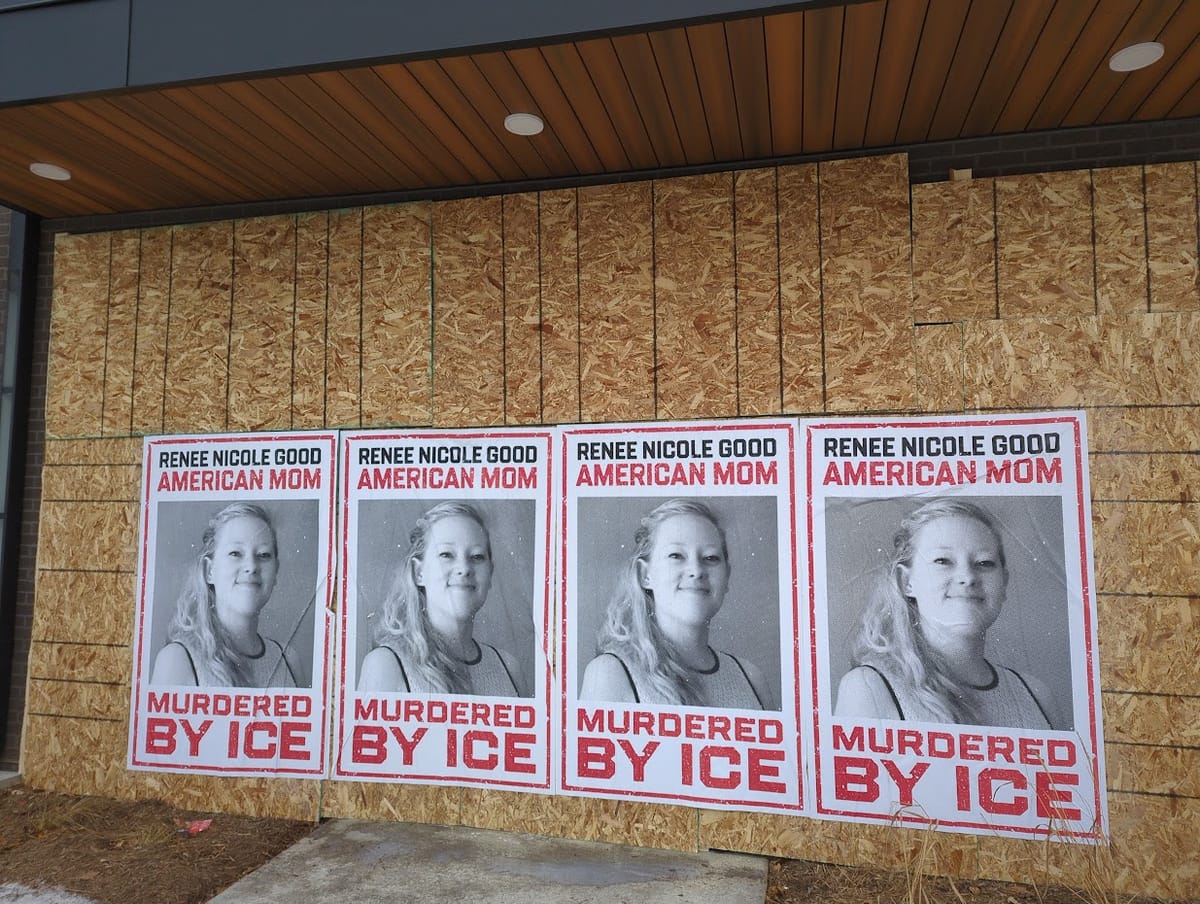
My own activities during Metro Surge were focused on financial support, patrol, and grocery delivery. I attended one noise demonstration the Friday after ICE murdered Renee. This demonstration was led by (what seemed to me) a loose combination of PSL and Sunrise Movement people. The first noise demonstration was advertised by DSA, which is how I found out about it, though future ones weren't. At the demonstration, illegal activity did occur, in the sense that blocking the street and shooting off fireworks are both illegal activities that people engaged in. (I blocked the street.) Police were present but stayed in their SUVs, which were surrounded by a crush of people. Major news networks were there. It was covered, even by Fox News, as a peaceful protest.
But future noise demonstrations escalated. Protesters attempted to chase ICE into hotels and successfully trespassed multiple times. In the most newsworthy of these demonstrations, protesters broke and vandalized windows, threw objects at ICE agents, and breached the hotel vestibule. Some of these protesters were then arrested. Black bloc protesters also involved themselves in ICE's riot in North Minneapolis. They vandalized and raided law enforcement vehicles. Some of them live-streamed it.
None of this is equivalent to shooting a cop. But none of it was guaranteed not to escalate to shooting a cop, either, and some of the video footage from some of the protests and actions are extremely unflattering to our cause. A practical and strategic analysis might involve itself in asking why, precisely, Minnesota's resistance enjoys the characterization it has, beyond random chance and no one shooting a cop. Influential community members advocating for adherence to nonviolence is certainly one major factor. Tim Walz made headlines for repeatedly urging us not to take ICE's bait, but lesser-known politicians like Jason Chavez, Elliott Payne, Doron Clark, and Zaynab Mohamed used mailing lists and social media to encourage us to assert our rights and protect our neighbors by patrolling in specific parts of the city and donating to food drives and legal fundraisers. What happened here was not remotely as simple as everyone deciding, all at the same time, to wrap ourselves in the American flag and declare our intent to save the country, and the resistance's strategies didn't originate with politically inactive "ordinary citizens". I'll be honest, I find this characterization flat-out insulting, but it's also revisionist, a quality that significantly undermines any claim to practical or strategic analysis. It certainly reinforces my belief in Hancox-Li's cynicism, though likely not in the manner she intended.
Conclusion
Hancox-Li never outright states what she thinks of black bloc tactics, aesthetics, and politics, but her essay in both tone and content seems to indicate some degree of distaste. That is okay: not everyone has to be an anarchist. Against Me! even has a song about this. Being a liberal doesn't prevent someone from writing a good analysis of anarchist activity, failed or otherwise. I do want to be upfront about my own views, however. Hancox-Li, as a liberal, invokes Minneapolis to be loud and wrong in her failed analysis of the Prairieland noise demonstration and its aftermath. She demonstrates motivated reasoning throughout her piece, seems to invent or distort facts without citation, and regularly discards detail that should inform a competent analysis. One of the articles she links mentions that Sanchez Estrada is a green card holder who may be deported after serving his 30-year sentence; while she thinks the sentence is unfair, she apparently doesn't believe that the human cost of such extreme sentences is relevant to a practical and strategic analysis of the defendants' actions, either in discussing their motives and behavior or in considering how such vulnerabilities might influence future organizing. She seems to have no position on whether or not anti-ICE campaigners should advocate for pardons for the Prairieland defendants. She exhibits a shallow understanding of how protest movements actually happen, and her cynicism, while evident, doesn't extend to doubting a word of federal prosecutors' claims. I knew going into the piece Hancox-Li and I differ in our politics, but I was shocked to find that we also differ in our idea of what constitutes an analysis. I don't consider "shooting a cop is a bad idea and you will go to jail for a very long time" to be a particularly interesting insight no matter how many times it's repeated. A magazine which purports to "create a home for mere liberalism, where the many conflicting currents of the liberal tradition can enter into productive conversation" should hold itself to higher standards than this.
Postscript: a note on guns
Liberal Currents is a reasonably popular magazine on Bluesky. Yesterday, as various self-identified liberals and leftists discussed the piece, people started arguing about Alex Pretti having been murdered while carrying a gun, in the context of heavy criticism of Hancox-Li's analysis. The Liberal Currents Bluesky account then reposted an essay from January, published just after Pretti was murdered, titled "Don't Buy a Gun". Both this piece and the people arguing about Pretti repeatedly conflate carrying a gun to a protest, carrying a gun during ICE observation/patrol, obtaining a gun for the purposes of armed insurrection against the state, and obtaining a gun for the purposes of joining a militia which intends to engage in armed insurrection against the state. All of these are meaningfully distinct goals. Some of them have stronger historical evidence to demonstrate their utility than others. The Civil Rights campaigners Hancox-Li admiringly references did carry and use guns, and most of them weren't ideologically committed to absolute nonviolence. Charles E. Cobb's book This Nonviolent Stuff′ll Get You Killed: How Guns Made the Civil Rights Movement Possible discusses the topic of armed self-defense at length. I strongly recommend reading it, and reading other books about both armed self-defense and armed insurrection.
What is missing most from this discourse is a common understanding of how the sausage actually gets made. Advocating for people to go to a protest and start shooting at cops is stupid as fuck and may well legally be some form of solicitation or incitement. Advocating for carrying a gun while traveling in a rural area where you might find yourself threatened by also-armed Nazis may or may not be a good idea, but performing legal acts of resistance in hostile areas produces a substantively different threat model than performing illegal acts while surrounded by law enforcement. My impression of Liberal Currents is that it's led by editors who share some of my goals, mean well, and are way more ignorant about modern resistance to authoritarianism than they realize. This ignorance produces poor analysis and generates annoying takes. My hope is that they eventually improve on this point.